You Don’t Have to Move to Ireland to Qualify in Ireland
From Diploma to Fellow — map your RCSI dental pathway
Overseas dentist? Here’s how you can reach Fellowship in General Dental Surgery (FGDS RCSI) in 3–5 years — from Diploma to Fellow, while you keep practising in your home country.
For most overseas dentists, the hardest part isn’t passing the examinations. It’s knowing which examination to sit first.
Every year we speak to internationally qualified dentists who have lost a year, and a set of exam fees, because they registered for the wrong Irish postgraduate dental qualification. Some assumed the Diploma in Primary Care Dentistry would carry exemptions towards the MFDS UK. Others didn’t realise they weren’t yet eligible to apply for the MGDS RCSI.
What used to be a seven-year climb to Fellowship in General Dental Surgery (FGDS RCSI) can now realistically be done in three to five years — and you don’t need to relocate to Ireland to begin. The Diploma in Primary Care Dentistry, the MFD RCSI examinations and the MGDS RCSI are all sat as online dental examinations from your location of choice, so your Irish postgraduate dental qualifications build while you keep working in your own clinic.
This guide maps the full RCSI dental career pathway for overseas dentists — every entry route, the eligibility criteria at each stage, and where candidates most often lose time.
🗺 The RCSI Dental Roadmap: From Day 1 to Fellowship
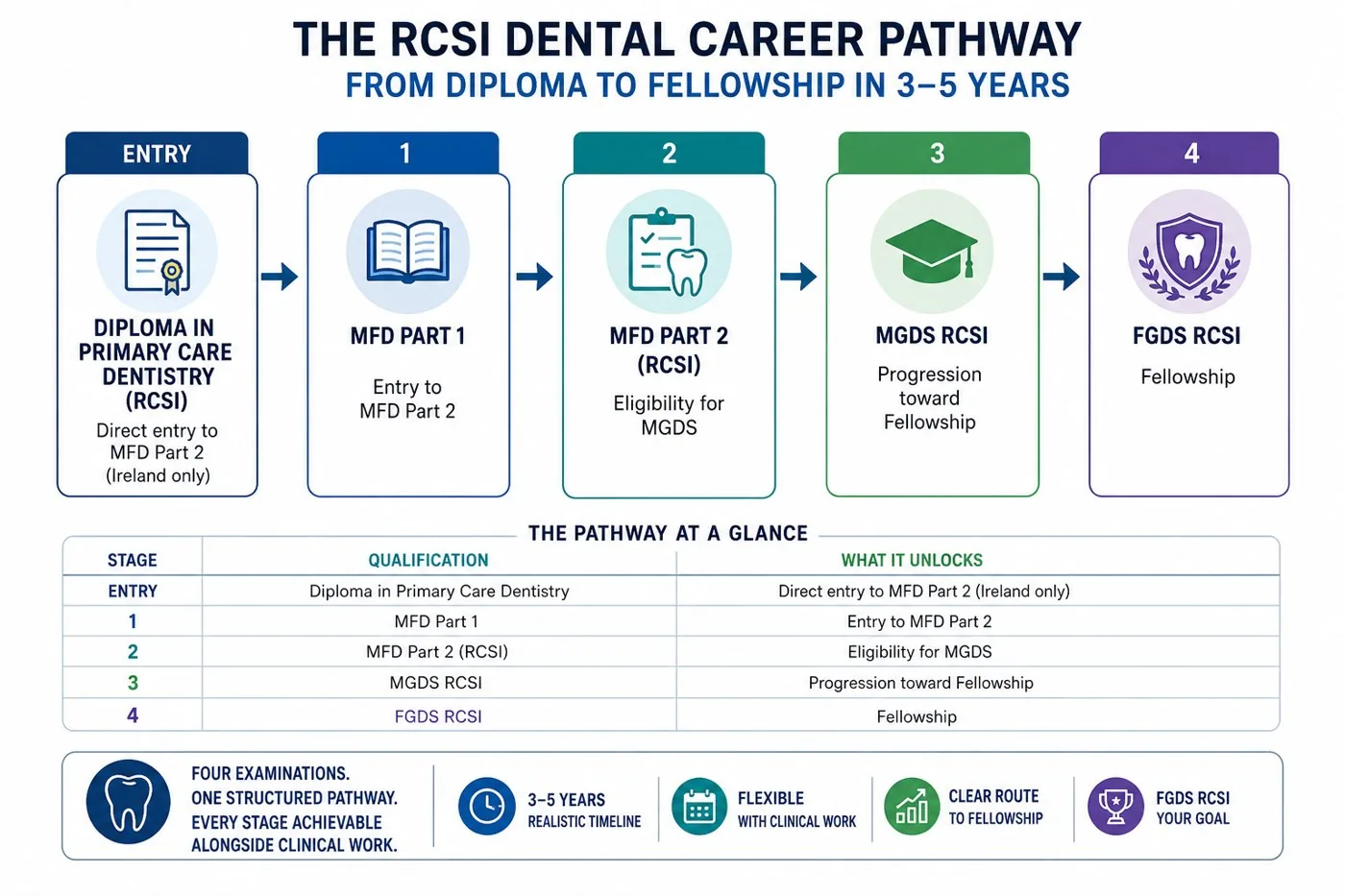
Step 1 — Diploma in Primary Care Dentistry (RCSI)
Best for: new dental graduates, dentists returning to clinical practice after a career break, and overseas practitioners wanting a recognised first Irish postgraduate dental qualification.
The Diploma in Primary Care Dentistry (Dip PCD) is a standalone RCSI qualification. You sit one exam, and it’s yours permanently — no further components, no logbook, no second sitting.
The Dip PCD exemption is where candidates are most often misled. It does let you skip MFD Part 1 and enter MFD Part 2 RCSI directly. It gives you nothing at all towards the MFDS UK or the MJDF — that exemption applies within the Royal College of Surgeons in Ireland only.
So if your long-term goal is Ireland, it’s the fastest entry route available. If it’s the UK, it won’t shorten your journey by a single step.
Step 2 — MFD Part 2 (RCSI)
The MFD Part 2 RCSI eligibility criteria are straightforward. You need a recognised dental degree with at least 12 months since graduation and 12 months of dental registration or licensure; MFD Part 1, MFDS Part 1, MJDF or the Diploma in Primary Care Dentistry; and a valid CPR or BLS certificate completed within the previous two years.
Unlike undergraduate exams, MFD Part 2 tests clinical judgement, decision-making and patient management rather than factual recall — which is why structured MFD exam preparation matters more here than raw study hours.
One change worth noting: from October 2026, MFD Part 1 moves to 150 MCQs (one correct answer, two distractors) plus 30 Single Best Answer questions. Part 2 is unchanged.
Step 3 — MGDS RCSI
Holding the MFD is what makes you eligible for the MGDS. The MGDS RCSI entry requirements are an undergraduate dental qualification, at least three years since graduation, and MFD RCSI, MFDS or MJDF obtained by examination — along with good standing with the Faculty of Dentistry.
The MGDS RCSI examination is sat online from anywhere in the world, in two written sections: a Clinical Reasoning Assessment and a Single Best Answer paper. Both must be passed.
The next MGDS RCSI 2026 sitting is in October 2026, and applications are open now. Preparation for this one needs to start well before the closing date, not after it. You can see how we prepare candidates for it on our MGDS RCSI course page.
Step 4 — FGDS RCSI
The FGDS RCSI is the highest level of achievement in primary dental care within the Royal College of Surgeons in Ireland, and it is recognised by the Dental Council of Ireland as a registrable additional qualification.
Note that FGDS isn’t simply another exam you book. Candidates complete a structured Faculty training pathway — additional supervised learning, or evidence of recognised prior learning — and become eligible for Fellowship on completing it.
📋 The Pathway at a Glance
| Stage | Qualification | Outcome |
|---|---|---|
| Entry route A | Diploma in Primary Care Dentistry | Direct entry to MFD Part 2 (Ireland only) |
| Entry route B | MFD Part 1 | Entry to MFD Part 2 |
| Stage 2 | MFD Part 2 | Eligibility for MGDS |
| Stage 3 | MGDS RCSI | Entry to the FGDS training pathway |
| Stage 4 | FGDS RCSI | Fellowship |
Four qualifications, one structured RCSI dental career pathway, every stage completed alongside clinical practice — and every examination available to overseas dentists without relocating.
⏳ Where Most Overseas Dentists Lose Time
- Sitting the wrong dental examination first, then repeating a year to correct it
- Assuming the Irish and UK dental pathways are interchangeable — RCSI and the UK Royal Colleges recognise different exemptions
- Missing a graduation or dental registration requirement by a matter of months
- Starting exam preparation once the deadline is announced rather than well before it
Each of these costs an entire exam cycle — a full year. A short conversation before you register usually prevents all four.
🎯 Where Should You Start?
Your correct entry point into the RCSI dental career pathway depends on your graduation year, your current dental registration, your clinical experience, and whether your long-term goal is dental registration in Ireland, the UK, or both. Working that out before you pay an examination fee is the single most valuable decision you will make in this pathway.
If you already know where you’re starting, you can browse all AceDent Academy courses here. If you’re not sure, that’s the conversation worth having first.
❓ Frequently Asked Questions
Do I have to move to Ireland to sit RCSI dental exams?
No. The Diploma in Primary Care Dentistry, the MFD RCSI examinations and the MGDS RCSI are all sat online from your location of choice, so overseas dentists can build Irish postgraduate dental qualifications while continuing to practise in their home country.
Does the Diploma in Primary Care Dentistry give exemptions for the MFDS UK?
No. The Dip PCD allows direct entry to MFD Part 2 with RCSI, but it carries no exemption towards the MFDS UK. The exemption applies within the Royal College of Surgeons in Ireland only.
What do I need to apply for the MGDS RCSI?
An undergraduate dental qualification, at least three years since graduation, and MFD RCSI, MFDS or MJDF obtained by examination, with good standing with the Faculty at the time of applying.
How long does it take to reach FGDS RCSI Fellowship?
With the current examination structure, the pathway from a first postgraduate dental qualification to Fellowship in General Dental Surgery can realistically be completed in three to five years, alongside full-time clinical practice.
AceDent Academy
AceDent Academy provides RCSI dental exam preparation for overseas dentists sitting Irish and UK postgraduate dental examinations — structured courses, mock exams, mentoring and exam guidance across the Diploma in Primary Care Dentistry, MFD RCSI, MGDS RCSI and the route to FGDS Fellowship.
Comments
Comments
Marriam
this is the clearest breakdown of the RCSI route i've seen anywhere. I was literally about to register for the Dip PCD thinking it counted towards MFDS UK. That section alone saved me a year. One thing im not sure about though, for the MGDS does the 3 years count from graduation or from when registration started?
8/4/2026, 10:07:40 AM